
Interior Plastering
Dot and Dab Plastering in Bournemouth and Dorset.
Board on Monday, skim on Tuesday. Flat walls from bent blockwork. Builders bring us in when the masonry is 20mm out of plumb and the programme can’t carry days of wet plaster drying. We dot, dab and skim properly so the second fix can crack on.
When Dot & Dab Is the Right Call
You have stripped a room back to bare blockwork. The walls are uneven, 10, 15, even 20mm out of plumb in places. You could build up multiple coats of wet plaster to straighten them, but that takes days of drying time between coats and uses a lot of material. Or you could dot and dab.
Dot and dab means fixing plasterboard directly to the masonry using dabs of adhesive. The board is pressed into position, levelled with a straight edge, and left to set. Once set, we skim the board to a flat, paint-ready finish. The whole process (board one day, skim the next) is faster than multi-coat wet plastering and gives you a dead-flat wall every time.
This is one of the most common jobs we do in Bournemouth period property renovations. The 1930s semis in Moordown, the Victorian terraces in Winton, the Edwardian houses in Southbourne. They all have solid brick or block walls that are rarely straight. Dot and dab sorts them out without the cost and disruption of metal stud framing.
Dot & Dab vs Metal Stud
Metal stud framing gives you a cavity for services and insulation, but it eats into your room size, typically 50 to 70mm per wall. Dot and dab only takes 12 to 15mm off the room. In small Bournemouth terraces where every inch counts, that difference matters. We will tell you which approach suits your project.
For full details on our boarding services, see drylining and plasterboarding. If your walls just need a fresh skim without boarding, check our domestic plastering and skimming page.
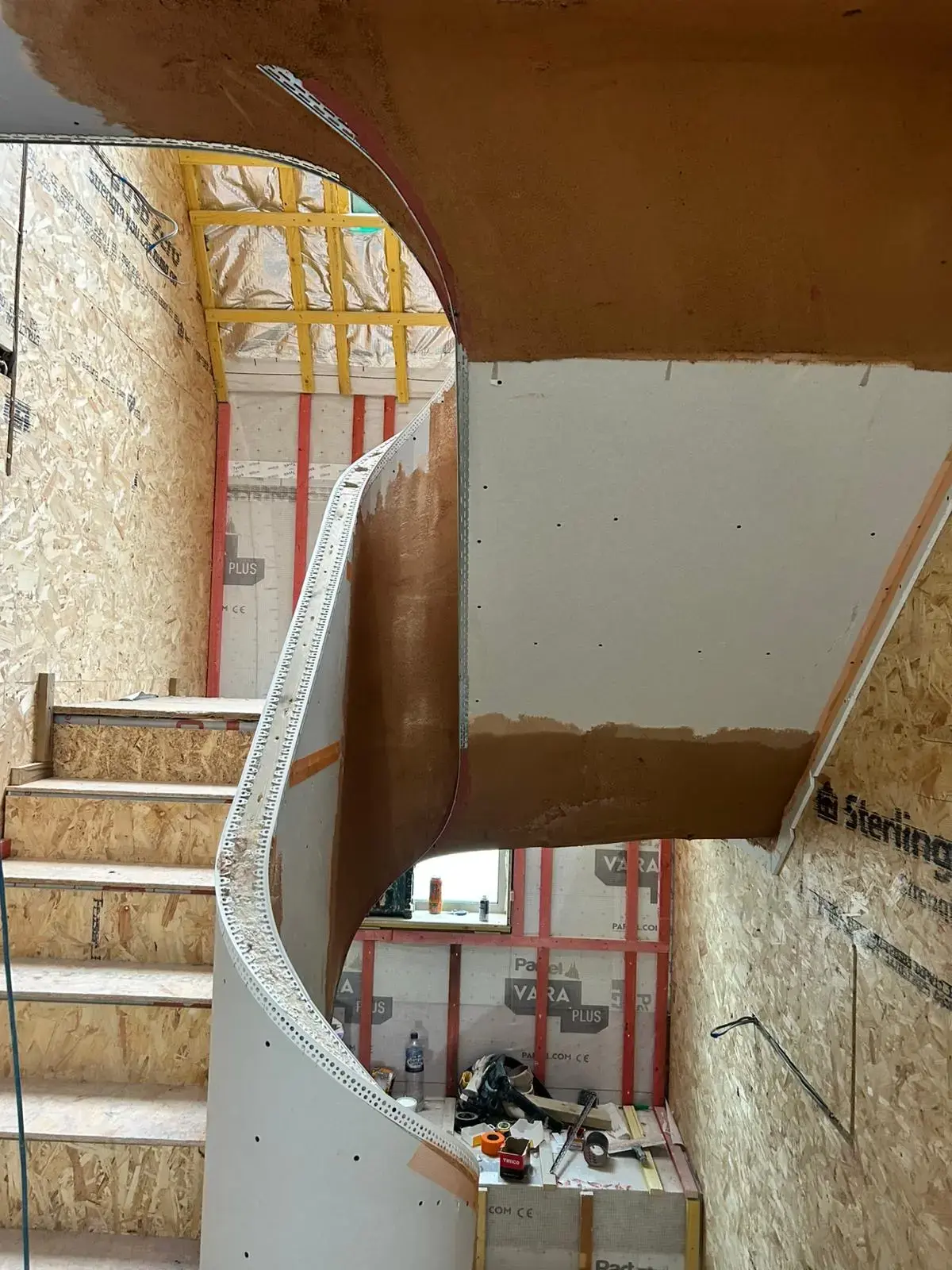
How dot & dab works
The process from bare masonry to paint-ready walls.
1. Survey the Walls
We check the masonry for damp, loose material and how far out of plumb it is. This tells us whether dot and dab will work or whether metal stud is needed.
2. Apply Adhesive Dabs
Gyproc Dri-Wall adhesive applied in a grid pattern to the wall face. Continuous ribbon around the edges, dabs at 450mm centres across the middle.
3. Fix & Level Boards
Plasterboard pressed into the adhesive and levelled with a straight edge. Each board checked for plumb and alignment before the adhesive sets.
4. Skim to Finish
Joints taped, then the full board surface skimmed with two coats of finish plaster. The result: a genuinely flat wall, ready to paint in 3 to 5 days.
Dot & Dab FAQs
Dot and dab is a method of fixing plasterboard to solid masonry walls using dabs of adhesive instead of timber battens or metal framing. The adhesive is applied in a grid pattern to the wall, the board is pressed into position and levelled, and then the board is skimmed to a smooth finish.
On solid masonry walls that are uneven, dot and dab is often faster and gives a flatter result than trying to build up multiple coats of wet plaster. It also provides a small air gap that improves thermal performance. However, wet plastering is better on walls that are already reasonably flat or where you want to preserve original features.
Yes, but you need to fix through the plasterboard into the solid masonry behind using the right fixings. For lighter items like pictures, standard plasterboard fixings work fine. For heavier items like wall-mounted TVs or shelving, we recommend drilling through into the blockwork and using frame fixings.
A typical room can be boarded in a day and skimmed the following day. Drying time is 3 to 5 days before painting. It is usually faster than a full wet plaster system, which needs multiple coats with drying time between each.
Related services from Pearl Plastering
Most dot and dab work runs into the trades below. One team, one phone number, no handover gaps.
Drylining & Plasterboarding
Dot and dab is one drylining method. We also fit metal stud partitions, ceiling boards and thermal laminate across Dorset.
Read moreDrylining Bournemouth
The Bournemouth-specific drylining page. Loft conversions, garage conversions and stud walls across the BH postcodes.
Read moreDomestic Plastering & Skimming
The skim coat that lands on the boards. Walls a decorator can roll straight onto.
Read moreTell us about the walls.
Tell us the room size and what state the masonry is in. We’ll come back inside 24 hours with a real number, and we’ll tell you straight if metal stud is the better call.